

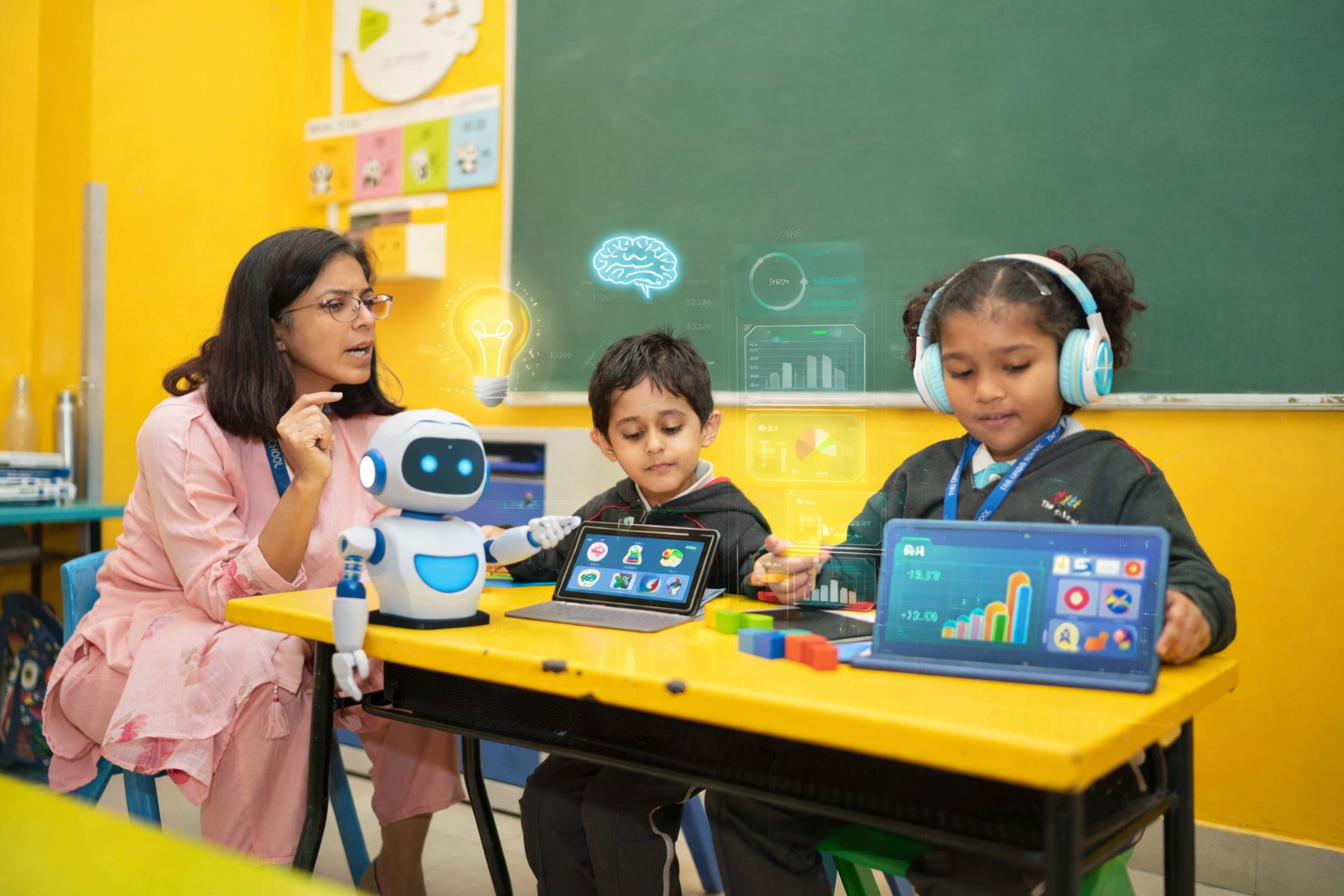
How AI and Technology Are Transforming Preschool Education
When parents hear the words Artificial Intelligence and technology in early childhood education, one concern often rises above all others: screen time. It’s a valid worry. Preschool years are meant for play, movement, conversation, imagination, and social bonding—not excessive exposure to digital devices.
The good news is that modern educational technology in preschools is not about putting children in front of screens. Instead, it works quietly in the background, supporting teachers, enhancing learning outcomes, and preserving what matters most—a child’s natural way of learning.
Let’s explore how AI and technology are positively transforming preschool education without increasing screen exposure. For more details, feel free to call us at +91-73737 35063.
1. Technology as a Teacher’s Assistant, Not a Child’s Screen
In today’s progressive preschools, AI functions mainly behind the scenes. It helps teachers track developmental milestones, understand individual learning patterns, and identify areas where a child may need additional support.
By reducing the burden of paperwork and manual assessments, technology allows teachers to focus on what truly matters—interacting with children, observing play, and guiding learning experiences. For children, the classroom still looks the same: stories, songs, puzzles, art, and hands-on exploration.
2. Personalised Learning Through Observation, Not Apps
Every child grows and learns at their own pace. AI-powered systems help educators analyse language development, motor skills, and social-emotional growth using real-world observations.
Instead of children using learning apps, teachers receive insights that help them plan personalised activities such as storytelling circles, sensory play, movement games, or role play. Learning remains active, playful, and child-led—never screen-based.
3. Smarter Planning for Play-Based Learning
AI also supports teachers in designing richer, more effective play-based experiences. It can help answer important questions like:
- Which activities best support fine motor skills?
- What types of stories engage children the most?
- How long should each activity last to keep young learners interested?
With these insights, educators create well-balanced daily schedules filled with art, music, outdoor play, group interactions, and creative exploration—without relying on digital devices for children.
4. Stronger Communication With Parents
Technology has also improved how schools communicate with families. Digital reports replace lengthy handwritten notes, and parents receive meaningful updates on their child’s progress and development.
Occasional photos or updates may be shared to keep parents informed, but without creating a culture of constant screen dependency. This transparency builds trust and helps parents extend learning at home through real-life activities, not screens.
5. Supporting Inclusive and Special Education Needs
AI-powered tools help educators identify early signs of speech delays, learning differences, or sensory challenges. Early identification enables early support—through hands-on therapies, guided play, and movement-based learning.
This proactive approach ensures children receive help when it matters most, long before screen-based interventions are even considered.
6. Preparing Children for the Future—Naturally
Preschool education isn’t about teaching children how to use technology. It’s about nurturing curiosity, creativity, communication, problem-solving, and social skills.
By supporting teachers with the right insights, AI ensures that children receive developmentally appropriate learning experiences at the right time—preparing them for a tech-enabled world without direct exposure to technology.
At The Orbis Schools, one of the best CBSE schools in Pune, technology is used thoughtfully and purposefully, with bare minimum screen time, ensuring that children benefit from innovation while enjoying a joyful, play-filled childhood.
Preserving the Joy of Early Childhood
AI and technology in preschool education are not replacing crayons, storybooks, or playgrounds. Instead, they are empowering teachers, enriching play-based learning, supporting individual growth, and protecting the essence of childhood.
When used wisely, technology doesn’t take away from early learning—it strengthens it, ensuring children grow through play, exploration, and meaningful human connection.
Archives
- Dec 2020 (1)
- Jan 2021 (4)
- Mar 2021 (2)
- Apr 2021 (3)
- May 2021 (3)
- Jun 2021 (1)
- Jul 2021 (2)
- Aug 2021 (3)
- May 2022 (1)
- Aug 2022 (2)
- Sep 2022 (1)
- Oct 2022 (2)
- Apr 2023 (2)
- Jul 2023 (1)
- Aug 2023 (2)
- Sep 2023 (2)
- Dec 2023 (3)
- Jan 2024 (2)
- Feb 2024 (5)
- Mar 2024 (4)
- Apr 2024 (4)
- May 2024 (3)
- Jun 2024 (3)
- Jul 2024 (4)
- Aug 2024 (4)
- Sep 2024 (4)
- Oct 2024 (5)
- Nov 2024 (4)
- Dec 2024 (4)
- Jan 2025 (3)
- Feb 2025 (3)
- Mar 2025 (3)
- Apr 2025 (4)
- May 2025 (3)
- Jun 2025 (4)
- Jul 2025 (4)
- Aug 2025 (3)
- Sep 2025 (4)
- Oct 2025 (3)
- Nov 2025 (4)
- Dec 2025 (3)
- Jan 2026 (4)
- Feb 2026 (3)
- Mar 2026 (3)
- Apr 2026 (3)
- May 2026 (5)
- Jun 2026 (3)
- Jul 2026 (4)
- Aug 2026 (4)
- Sep 2026 (3)
- Oct 2026 (3)
