

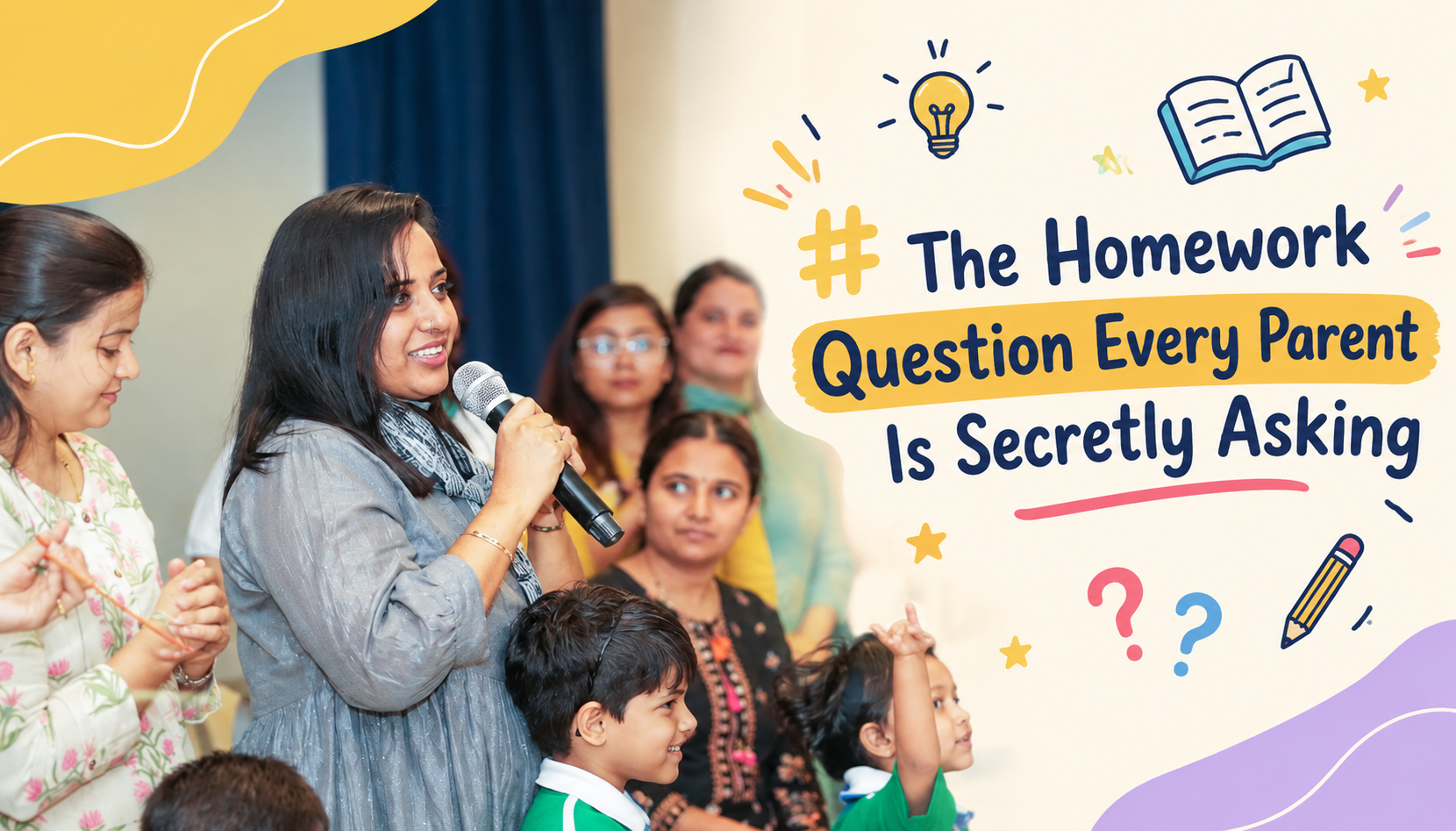
The Homework Question Every Parent Is Secretly Asking
Picture this: it is 8 pm on a Tuesday. Your eight-year-old has been at school since 7:30 in the morning. She has had lunch, sat through a maths test, dealt with a disagreement with her friend and spent most of the day learning. Now she is sitting over a homework worksheet, slowly moving her pencil across the page, clearly tired.
You are sitting next to her probably wondering the thing many parents do: Is all this homework really helping?
If this sounds familiar you are not alone. There has been a lot of discussion around how much homework children need, particularly in the primary years.
For parents looking at schools in Pune the school’s approach to homework may not be at the top of the checklist. Perhaps it should be.
Looking for a school that balances academics, home learning, play, and student well-being? Connect with The Orbis School at +91-73737 35063 to learn more about our approach to education.
Let’s Look at the Numbers
Educational researcher Harris Cooper reviewed more than 180 studies on homework and found that for primary school children there is little to no clear connection between homework and academic achievement.
His well-known "10-minute rule" suggests around 10 minutes of homework per grade level each night. That would mean 10 minutes for Class 1, 20 minutes for Class 2, and so on.
There is another side to the discussion too. A 2021 Stanford University study found that students in high-homework environments reported higher levels of stress. In the study, 56% of students identified homework as their source of stress, ranking it above exams, friendships and family conflict.
For children that balance matters even more.
Yet many CBSE schools in Pune and across India continue to give primary school students 60 to 90 minutes of homework on a basis. That can be times more than what the research suggests.
What Does a Child Really Need After a Long School Day?
By 8 pm a child needs more than another homework worksheet.
Children between the ages of 6 and 12 need around 9 to 12 hours of sleep each night. They also need 60 minutes of physical activity every day. Then there is something that can be easy to overlook: time to simply play, talk, explore and relax.
Unstructured play has a role in childhood. Research has linked it with improvements in function, including attention, decision-making and emotional regulation.
These are skills children use every day. They are also skills that do not always come from completing another page of written work.
The best schools in Pune and other places are beginning to look at homework not simply in terms of how much work can be given, but whether that work is actually useful for the child.
So What Should Home Learning Look Like?
This does not mean that homework needs to disappear.
It means that perhaps we need to rethink what we call homework.
Of hours of repetitive worksheets, home learning can be short, purposeful and connected to a child’s everyday life. It could be reading a book for 15 minutes, observing something in nature and recording it in a journal or discussing a question around the dinner table.
The point is not to keep children busy after school. It is to give them something to think about without taking away the time they need to rest and be themselves.
The Orbis Perspective
At The Orbis School we believe the time children spend outside school matters as much as the time they spend in the classroom.
That is why our approach to home tasks is focused on encouraging curiosity rather than simply adding more work to a child’s evening. We want children to have time to read, play, talk to their families pursue their interests and get rest after a full day at school.
Because learning does not stop when homework is completed.
A child who is curious about learning will naturally want to keep exploring asking questions and discovering things.. That is something worth protecting.
Admissions, for 2027–28 are open. Visit The Orbis School website to know more.
Archives
- Dec 2020 (1)
- Jan 2021 (4)
- Mar 2021 (2)
- Apr 2021 (3)
- May 2021 (3)
- Jun 2021 (1)
- Jul 2021 (2)
- Aug 2021 (3)
- May 2022 (1)
- Aug 2022 (2)
- Sep 2022 (1)
- Oct 2022 (2)
- Apr 2023 (2)
- Jul 2023 (1)
- Aug 2023 (2)
- Sep 2023 (2)
- Dec 2023 (3)
- Jan 2024 (2)
- Feb 2024 (5)
- Mar 2024 (4)
- Apr 2024 (4)
- May 2024 (3)
- Jun 2024 (3)
- Jul 2024 (4)
- Aug 2024 (4)
- Sep 2024 (4)
- Oct 2024 (5)
- Nov 2024 (4)
- Dec 2024 (4)
- Jan 2025 (3)
- Feb 2025 (3)
- Mar 2025 (3)
- Apr 2025 (4)
- May 2025 (3)
- Jun 2025 (4)
- Jul 2025 (4)
- Aug 2025 (3)
- Sep 2025 (4)
- Oct 2025 (3)
- Nov 2025 (4)
- Dec 2025 (3)
- Jan 2026 (4)
- Feb 2026 (3)
- Mar 2026 (3)
- Apr 2026 (3)
- May 2026 (5)
- Jun 2026 (3)
- Jul 2026 (4)
- Aug 2026 (4)
- Sep 2026 (3)
- Oct 2026 (3)
